Thousands of Answers: Resourcing Movement Media for Justice

“There’s no single answer that will solve all of our future problems. There’s no magic bullet. Instead there are thousands of answers – at least. You can be one of them if you choose to be.” – Octavia Butler
About a year ago, I had the opportunity to see Octavia Butler’s typewriter in-person at the National Museum of African American History and Culture. After laying eyes on the award-winning writer’s light blue Olivetti Studio 46, I left feeling acutely aware that Butler used her typewriter as a time machine, a tool through which she built cautionary and liberatory worlds.
In her essay, “A Few Rules for Predicting the Future," written at the turn of the 21st century, Butler addresses the impossibility of predicting the future. Yet, she also acknowledges that there are a multitude of paths to solve future problems – should one feel compelled to choose those routes.
So, what does Octavia Butler have to do with People’s Media Fund (PMF)? The 2025 Community Voices grantees are filled with people, projects, and organizations focused on challenging systemic oppression and building community and narrative power. Similar to Butler, they understand that it will take a diverse array of media tactics, or “thousands of answers,” to change minds, behaviors, and structures.
For five years, the Community Voices Open Call has moved resources to projects and organizations that amplify community-led storytelling and mediamaking. With the rise of fascism and strategic attacks on media, information, and culture, this year’s open call specifically supported work that strengthens social justice movement-building and organizing in the Philadelphia region through community storytelling, news and information, and archives.
This year, PMF received 95 applications to the Community Voices Open Call, and $770,000 was awarded to 32 organizations and projects, with grants ranging from $10,000 to $30,000. Regardless of issue area or media form, these grantees recognize the essential role that narratives play in shaping how people understand and engage with others and the world around them. I encourage you to check out the full grantee list, but just to spotlight a few:
- CAIR-Philadelphia will combat rising anti-Muslim racism by sharing stories and videos of resilience and hope through their “Beyond Islamophobia” project.
- Care, Not Control will continue to increase awareness of juvenile justice issues through their podcast, Uncaged Potential, developed by directly-impacted youth.
- Philly Black Worker Project will launch “With All Due Respect," a worker-led campaign to amplify the voices of Black workers navigating exploitative labor conditions.
- VietLead will expand "Taking Root," a community-organizer-produced documentary series which seeks to build cross-racial solidarity and mobilize Southeast Asian communities.
When media is in the hands of community members, they begin to develop political agency and imagine alternative futures, a shift which PMF Board Member and Communications Scholar, Dr. Clemencia Rodríguez spoke about, while discussing the power of community media in a recent Generocity article.
It’s no secret that we’re living through dire times, especially as it relates to news and media. In a time when the world’s problems can feel so immense, and most of us feel inadequate in the face of them, the Community Voices grantees help us remember that we’re not alone. These grantees remind us of our collective power and ensure that diverse communities can not only survive, but also have the space to dream up liberatory futures.
Decision-Making For Community, By Community
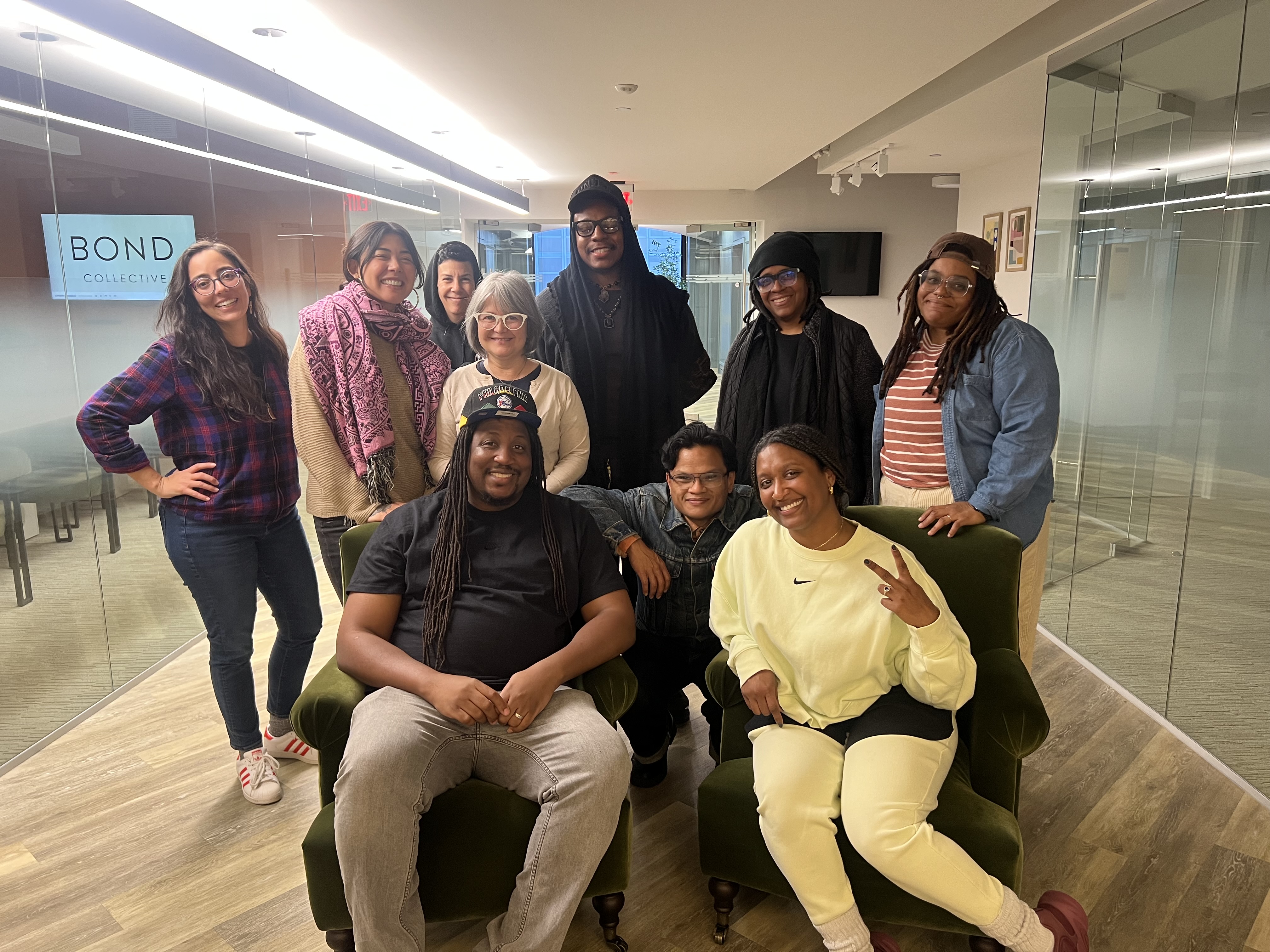
A group shot of the 2025 Community Voices panelists and facilitators
Since 2023, People’s Media Fund has utilized a participatory grantmaking process for this fund, which shifts power away from the foundation and toward the community through transparent grantmaking. This year, applications were evaluated by a panel of nine community members who have strong relationships and experience with movement building and/or mediamaking. Panel decisions are made by consensus, without influence from PMF staff or board members. This builds trust and allows each panelist to stand in their expertise and assess where to champion an applicant and where to yield to another perspective.
As part of this year’s process, panelists received a framework for decision-making, rooted in PMF’s values—as well as two trainings led by co-facilitators, Andreana Barefield and Nigel Charles. During these sessions, panelists learned about PMF’s history and the importance of participatory grantmaking. They were also encouraged to stretch beyond their personal comfort zones and consider how they would show up differently as it relates to traditional philanthropy. From that conversation, they created the following reminders to ground them in their work:
- Take risks (since philanthropy is often so risk-adverse)
- Keep it accessible (if everyone can’t understand it, who is it really for?)
- Beware of funding trends (what’s in fashion may not be what’s most important)
- Avoid co-opting others’ stories and struggles (own what is yours, honor what is theirs)
- Be open to mediamakers/organizers from different vantage points (anyone can have impact)
- Value relationships and community engagement (just as much as technical skills and formal training)
- Resist only funding established organizations (larger scale ≠ larger impact; small can be all)
- Interrogate what is news (and who gets to decide that)
- Challenge and push ourselves (where can we stretch and what can we learn?)
I share this list with you because it’s a powerful reminder of why community members are at the heart of this decision-making process. They are the experts here, not PMF staff or board, as they bring intimate knowledge and experience of what it actually means to do the kind of work we fund, on-the-ground and in community. This level of expertise, paired with radical compassion, proves unmatched.
Relationships are Everything
Many moons ago, Denise Brown (a friend, mentor, and former colleague of mine at Leeway Foundation) told me that “relationships are everything” – and she was most certainly right. At multiple points during the Community Voices process, relationships reigned supreme. Not only were panelists able to bring their community relationships into the mix, but they were also able to cultivate deeper networks for change.
Last year, my colleague and fellow program staffer, Samíl Jimenez-Magaleno, wrote about the potential of participatory grantmaking as a site for breaking silos and deepening movements, and this message was reinforced again this year. During breaks at our in-person panel meeting, I witnessed panelists building relationships, sharing organizing strategies, and making plans to connect beyond PMF’s work.
It’s affirming to hear that panelists found the process generative. One panelist noted that “the dynamic of multiple, diverse perspectives coming together to assess applications was enriching” and that being on the panel allowed her to “build deeper connections and strengthen progressive community in the city.” Another, who had been part of various different grantmaking panels, shared that being a PMF panelist was “a really meaningful learning experience” and that “practicing a mindset of abundance rather than scarcity is something [they’ll] keep holding onto.”
The collective effervescence expressed by panelists not only showcases how the process allowed for deeper thinking and analysis of the issues they cared about – but also illustrates a deeper sense of solidarity and connection with each other and the movement media community at-large.
Takeaways for Fellow Funders
I think about all of PMF’s Community Voices applicants, some who became grantees, and others who did not, but all who demonstrated a vulnerability to apply and engage in our grantmaking process. From my (privileged) position in philanthropy, I’ve witnessed how grantmaking processes often play out for people and organizations that exist on the margins, organizations whose work is often ignored or silenced because of what they create or who they are, organizations who are often chronically underfunded.
While the number of funders engaging in participatory grantmaking has increased in recent years, it’s still disappointing (albeit not surprising) to know that only 42% of funders engage in participatory grantmaking. If we, as funders, believe in equity and justice – particularly for Black and Brown people, Indigenous communities, poor and working-class folks, immigrants, LGBTQIA communities, and other marginalized groups – than we can and must do better at shifting our power.
Transforming philanthropy to operate in service of communities requires a fundamental shift in how we, as grantmakers, work. Here are two takeaways to explore or deepen that work at your respective spaces:
- Learn from participatory grantmakers: Here’s the good news! Participatory grantmaking is not a new practice. There are some great resources to support all stages of this work, such as Justice Funders’ Resonance Framework or the Fund for Shared Insight’s Participatory Philanthropy Toolkit. There’s so much more to be gained than lost when shifting power toward community.
- Take a chance on funding narrative change: Consider what it would look like to invest in narrative work. Yes, this is for you – even if your space hasn’t traditionally supported it! While narrative change can feel like an emerging field, its role in advancing justice has been crucial. What might funding storytelling, mediamaking, and culture look like for your space? If you’re new to narrative shift work and don’t know where to start, let me recommend Convergence Partnerships’ Funding Narrative Change Framework or this recent Nonprofit Quarterly article, “How to Fund Like a Narrative Strategist,” where four co-authors make the case for narrative strategies support.
To conjure Octavia Butler once more: There’s no one way to achieve our goal – there are “thousands of answers” – and it will take all of us working together, chipping away at old models and building new structures, to support the equitable and inclusive world we all deserve. At People’s Media Fund, we remain curious and committed to refining our grantmaking processes, and we’re celebrating our 2025 Community Voices grantees who are using movement media for social justice!
Header photo credit: Philly Black Worker Project